


Did You Really Need to Retime that Corridor?
.png)
Agencies across the country are telling us that they feel like they are wasting a lot of their retiming budgets on signals that timing can’t improve. Candidates are being selected by where performance is worst, yet they are frequently the ones with the least room to improve. Even when the retiming is completed, at real cost, delay barely moves.
Agencies have been asking us to develop a methodology that enables them to know what the improvement potential of a corridor is, before they’ve invested tens of thousands of dollars on retiming them.
This blog details a new methodology developed by Flow Labs, the Improvability Index, that is helping agencies do just that.
How agencies pick retiming candidates today
Most agencies prioritize signals for retiming roughly once a year, through a process that is lengthy and involves extensive stakeholder coordination. It generally follows one of three methods:
- Fixed schedule. A set rotation that works through signals and corridors in a predetermined order, typically retiming a third or a fifth of their signals each year.
- Call for projects. Candidates are gathered from across the region from divisional engineers, typically ranked by the most recent complaints.
- Data-driven prioritization. Performance measures used to identify where signals are running poorly.
Each of these methods share the same blind spot: they identify where performance is poor, not whether retiming can actually improve it - engineers end up frustrated and agencies leave money on the table.
Poor performance does not equal opportunity
Many of the worst-performing locations cannot be corrected through signal timing at all. A signal already at capacity, with its cycle length exhausted, has no time left to redistribute. Retiming it again leaves delay unchanged. Prioritizing by performance then sends crews to these same signals year after year, where the work returns little or nothing. Those signals need an alternative treatment - possibly expansion - and that budget could be better spent elsewhere.
What the Improvability Index shows
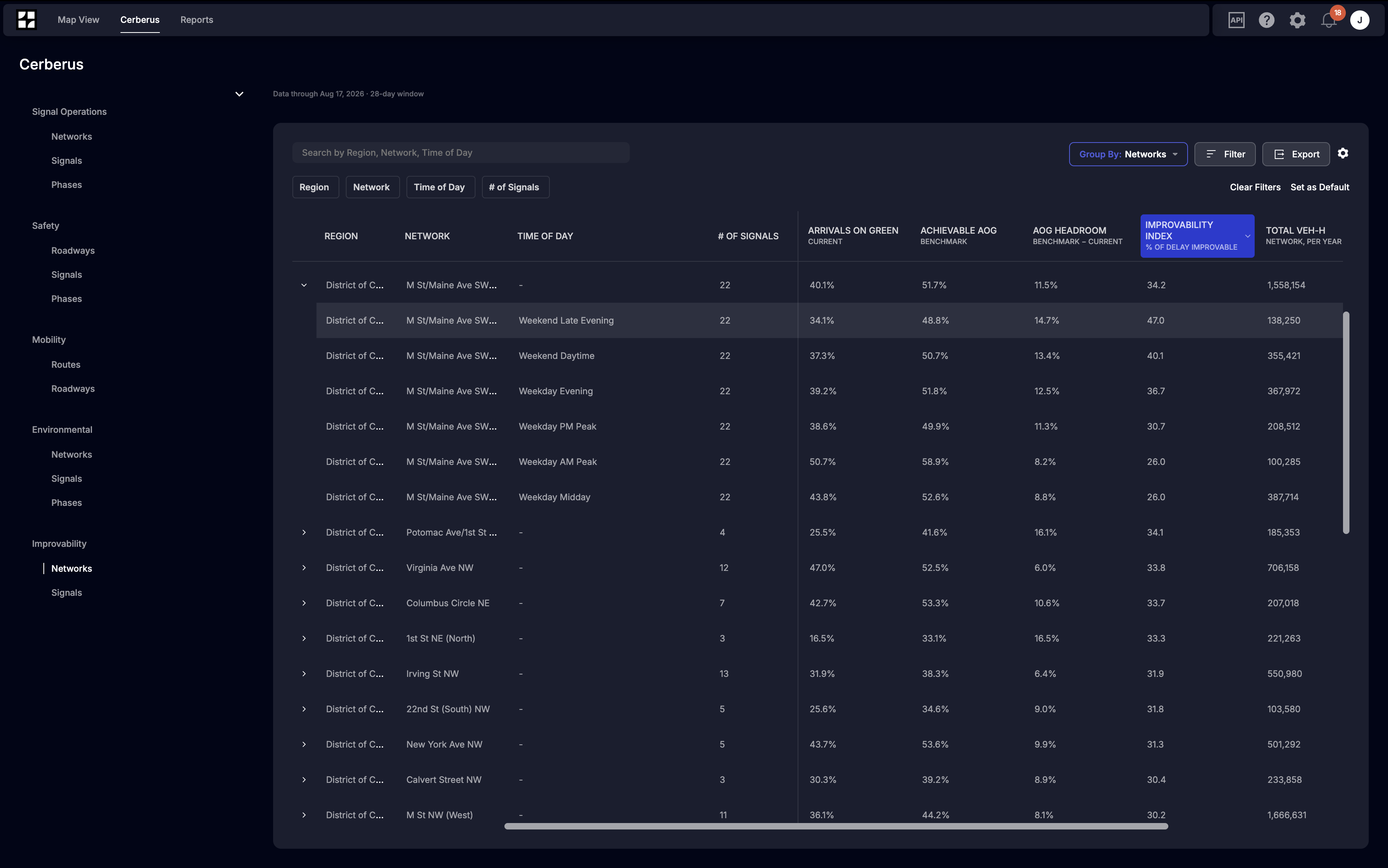
Flow Labs' Improvability Index helps agencies understand the potential opportunity for improvement at a signal and a corridor. It uses our proprietary models to benchmark each signal against comparable signals across the country accounting for intersection geometry, capacity, demand and other critical factors to estimate how much improvement is realistically available, both at the individual intersection and across the full corridor.
This process allows for prioritization based on the potential impact of a retiming. A poorly performing, saturated intersection with no headroom now falls back down to the bottom of the list. A corridor with genuine room to improve, even one generating no complaints, rises to top.
Where the improvement comes from
The Index also identifies where the improvement opportunity comes from:
- Offset optimization. The improvement available from offset changes alone and their impact on arrivals on green.
- Split, cycle, and other timing changes. The improvement that comes from other adjustments to the timing plan.
When the majority of the benefit lies in the offsets, the correction is a matter of hours rather than a full study, allowing each retiming to be scoped to the opportunity rather than a rebuild of every plan by default.
.png)
.png)
Improvability by time-of-day period
Most agencies retime every time-of-day plan on a corridor, even for periods of the day that don’t need it. The Improvability Index scores improvability for each period independently. If the AM and midday plans are already near optimal and only the PM peak has room to improve, the agency can retime that single period and leave the rest. This allows agencies to economize and run a leaner retiming process.
What agencies get out of it
- Sharper selection means more funding. Effort is concentrated on the locations where improvement will be largest. Defensible results make the next round of investment easier to justify.
- Less wasted spend. Agencies stop funding retimings that timing cannot fix. If you're retiming 500 signals each year, misdirecting 20% of your retiming efforts to the wrong signals results in up to $500,000 of wasted spend.
- Broader coverage. Lighter retimings, often only a few time-of-day periods per network, allow agencies to cover more corridors within the same cycle.
Find out what's worth retiming
Before your next retiming cycle, see which of your signals can actually be improved, and by how much. The Improvability Index is available today as a limited access feature on the Flow Platform and it can be run instantly across your entire network. Contact our team to get it running on yours.
Manage every traffic management system and data in one platform, without the need for new hardware.
.avif)

