


Getting Ahead of Gridlock with Spillback Metrics
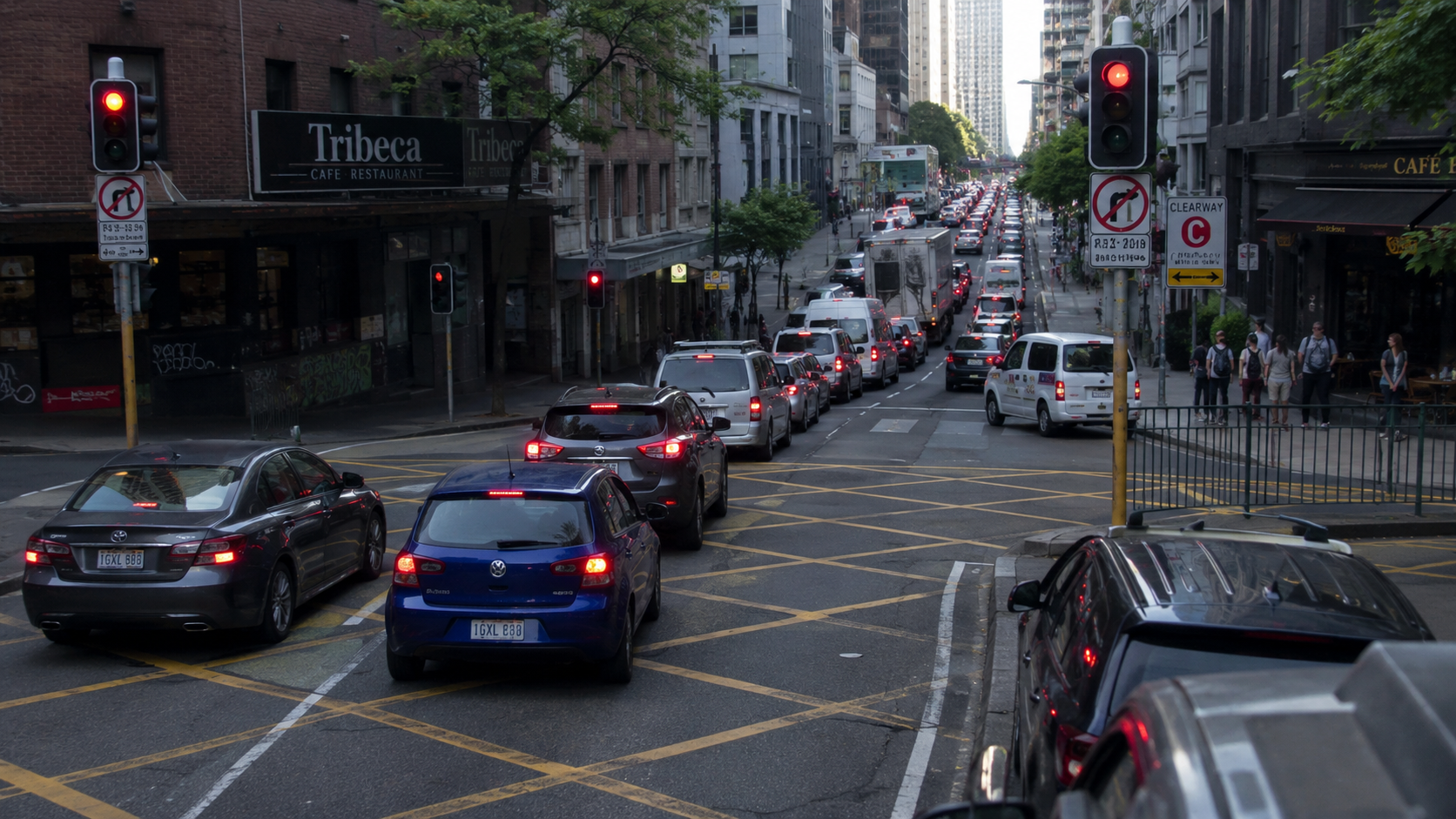
Every driver in a major city has been here before. The light is green but there’s nowhere to go — the vehicles downstream have queued up so much that you can’t cross the intersection. This is spillback, and it is now a metric in the Flow Platform.
What is Spillback?
Spillback happens when a queue grows longer than the road meant to hold it. Something downstream backs vehicles up: a red phase, a metered ramp, an oversaturated left turn. If the queue is shorter than the road length, it’s manageable and just impacts one intersection. But when it grows past the available storage and reaches back through the upstream intersection, it becomes a corridor problem.
At that point the upstream approach can receive a green and discharge nothing, because there is no room downstream to release into. The approach keeps filling, its own queue climbs, and the failure spreads backward through the network one intersection at a time. A single constrained movement can gridlock an entire corridor.
That backward spread is what makes spillback expensive. A split failure costs part of one phase. Spillback wastes green at intersections that were timed correctly and pushes the congestion onto signals that were operating correctly.
Why it matters more than queue length alone
The same queue can be routine on one link and a blocked intersection on another. 400 feet on a 900-foot link is normal operation. 400 feet on a 300-foot link is gridlock. Spillback measures the queue against the storage available to hold it, so the vehicle count alone does not indicate whether a location is at risk.
Spillback has a number of major consequences:
Lost capacity. Green time at the upstream intersection that discharges nothing is capacity you have allocated but is now wasted. Retiming that intersection will not recover it, because the constraint is downstream.
Cascading failure. Spillback spreads backward against traffic, so the delay and stops appear far from the cause. Teams investigate the symptomatic intersection instead of the one creating the queue.
Safety. Queues reach places they were never meant to: over a pedestrian crossing, across a railway, up an off-ramp onto the mainline. That turns congestion into crash risk.
Seeing it without hardware
Loop detectors can only measure as far as the advance detector, usually 300 to 350 feet from the stop bar. Any queue longer than that is invisible to them, and spillback is longer than that almost by definition.
We measure queue lengths from connected vehicle data — full visibility at scale with no hardware required. The metric runs continuously at the movement, phase, and signal level, so spillback becomes something you monitor and alert on rather than something you learn about from a complaint.
The visualization displays that data. You can watch queues build cycle by cycle and see the moment a queue reaches the upstream intersection and spills back.
What can you do about it?
Spillback is a storage problem, so every fix either keeps the queue shorter than the link or moves it somewhere it does no harm. In rough order of cost and effort:
Fix the offset. The most common cause is an upstream intersection releasing a platoon into a link that has not cleared. Set offsets so the downstream queue discharges before the platoon arrives. This frequently requires only a timing change.
Rebalance the splits at the bottleneck. If the constrained movement cannot clear its queue within the cycle, the queue only grows. Give it enough green to discharge what arrives.
Match cycle length to storage. Long cycles build long queues. On a short link, a shorter cycle keeps each cycle’s queue inside the available storage at the same capacity.
Meter the demand upstream. When the bottleneck cannot be widened, hold vehicles upstream where storage exists. This relocates the queue to a place where it blocks nothing critical.
Fix the movement causing it. Spillback often traces to one turn: a permitted left that cannot clear, a right blocked by through traffic. Adjusting the turn treatment drains the queue at its source.
Add storage. Lengthening a turn bay or adding a lane raises the point at which a queue becomes spillback. It is the slowest and most expensive fix, and sometimes the only durable one.
Then watch the metric. Spillback moves through the day as demand shifts. Fix it at one intersection and it can reappear two signals downstream. Standing alerts turn a recurring problem into a condition you manage deliberately.
The Next Generation of Signal Performance Measures
Spillback for a long time has been something that engineers reconstructed after the fact, from complaints and windshield surveys, and often cleared by the time an engineer arrived to observe it. Measuring it continuously changes the work from reacting to a corridor that has already failed to catching the conditions that cause it. That is the value of measuring it directly.
To find out more about how you can get access to spillback data, get in touch with the Flow Labs team at contact@flowlabs.ai.
Manage every traffic management system and data in one platform, without the need for new hardware.
.avif)

